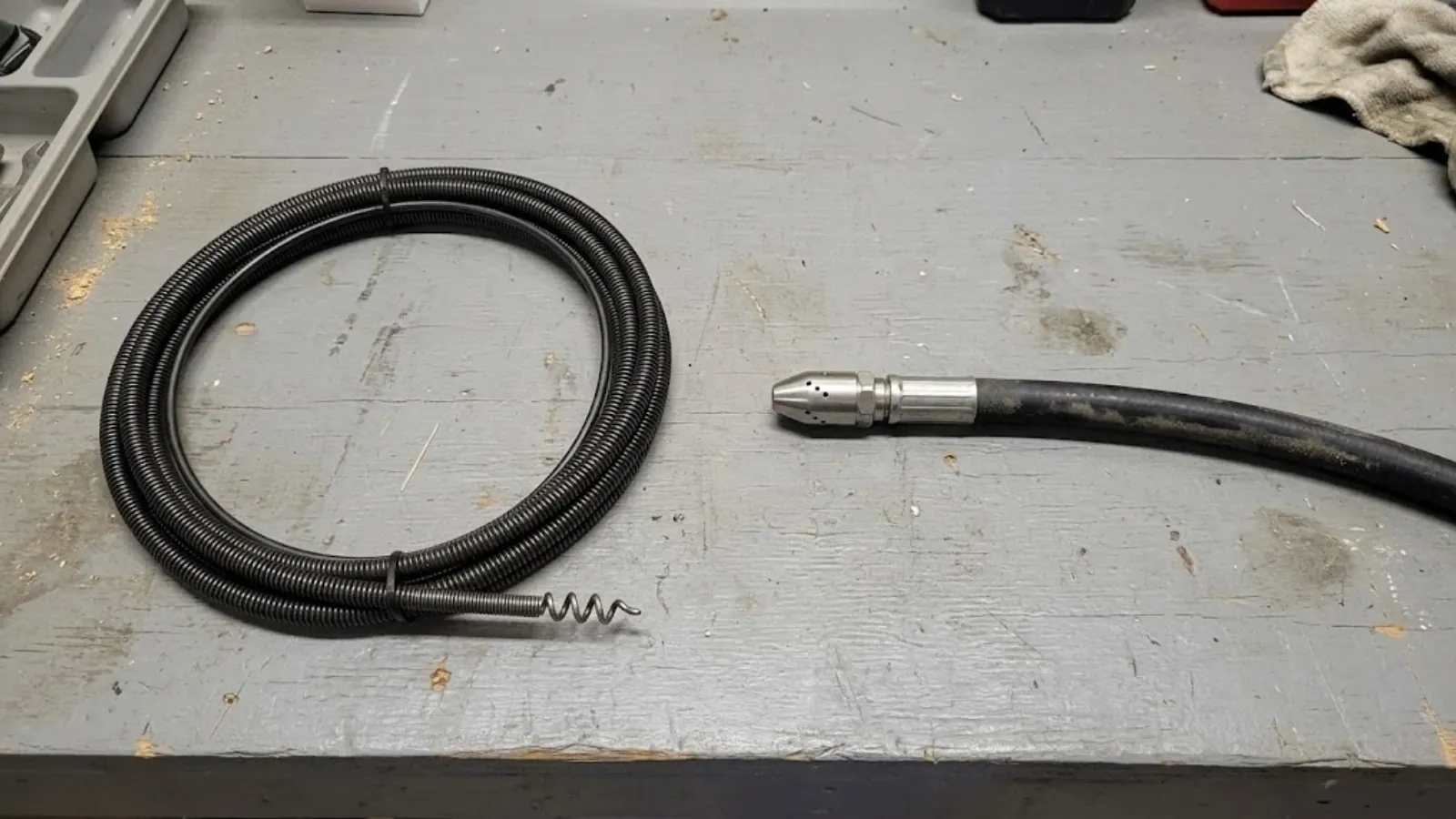
A clogged drain can be cleared two very different ways, and picking the wrong one often means paying for the same clog twice. Here is the real difference between cabling and hydro jetting, and when each one actually makes sense.
How A Cable Snake Actually Works.
A cable, or drain snake, is a flexible metal cable with a cutting or auger head that a technician feeds into the drain to physically break through a blockage. It is fast, relatively inexpensive, and effective for a single, isolated clog such as hair in a bathroom drain or food debris in a kitchen line.
The cable punches a path through the obstruction, restoring flow, but it does not necessarily clear material attached to the pipe walls along the way, which is the real limitation worth understanding upfront.
How Hydro Jetting Works Differently.
Hydro jetting uses a specialized nozzle to blast high-pressure water through the full diameter of the pipe, scouring grease, scale, and root intrusion off the interior pipe walls rather than just punching a path through the center of the blockage.
This is a more thorough process that takes longer and costs more per visit, but it addresses the buildup itself rather than leaving a narrowed channel behind after the visible blockage clears, which is exactly the gap a simple cable pass tends to leave behind.
When Cabling Is Genuinely The Right Call.
A single, first-time clog in an otherwise healthy drain, such as a bathroom sink slowed by hair or a toilet clogged by an isolated flush, is a good candidate for cabling. There is no established pattern of repeat problems, and a faster, less expensive fix is the reasonable first step rather than jumping straight to a more involved process the situation does not actually call for yet.
When Hydro Jetting Is The Better Investment.
A line that has clogged more than once in a short period, especially at the same location, is showing a pattern that a simple cable pass will not resolve for good. Whatever caused the buildup the first time is very likely still coating the pipe walls.
Root intrusion in an older clay or cast iron lateral, common in Prescott's historic core, is a particularly strong case for jetting, since roots regrow through the same gaps a cable simply pushed past rather than removed.
How Often A Jetted Line Needs It Again.
A properly jetted line, especially one dealing with root intrusion, typically holds up well for a year or more before needing attention again, compared to a cabled line that may clog again within weeks or months on the same underlying problem.
Root growth does eventually return in an untreated clay lateral, which is why a line with a known root intrusion history sometimes goes on a planned annual or biannual jetting schedule rather than waiting for the next clog to force the issue.
Is Jetting Safe For Every Pipe Type.
Modern PVC and cast iron generally handle jetting's water pressure without issue, but a genuinely old or already deteriorating clay line can sometimes be too fragile for aggressive jetting without first confirming its condition through a camera inspection. This is part of why a camera check often precedes a jetting recommendation rather than jumping straight to the more forceful option on a line of unknown condition.
A Quick Way To Think About It.
If a drain has never clogged before, start with cabling. If the same drain has clogged more than once, or a camera shows grease coating or root intrusion along the pipe wall, jetting is very likely the better investment even though it costs more upfront. That simple rule covers the large majority of real-world decisions without needing to overthink every individual case, and we are always glad to walk through the specifics of yours before recommending either one.
Grease-Heavy Kitchen Lines Are A Special Case.
A kitchen line with a history of grease buildup benefits especially from jetting, since grease coats the full pipe wall rather than collecting in one discrete blockage a cable can punch through. A cable may clear the immediate symptom on a grease-heavy line, but the coating left behind sets the line up to clog again within weeks, which is a recurring and frustrating pattern until the line actually gets jetted clean.
What A Camera Inspection Adds To The Decision.
When a line has clogged repeatedly or the cause is unclear, a camera inspection before choosing a method shows exactly what is actually happening inside the pipe, whether that is grease, roots, a bellied section, or something else entirely.
This turns a guess about which service to buy into an informed decision based on what the camera actually shows, which is a better use of the diagnostic cost than skipping straight to a repair method and hoping it works out on the first attempt.
The Honest Cost Comparison.
Cabling costs less per visit, but a line that keeps clogging every few months effectively costs more over a year or two than a single jetting visit that actually resolves the underlying buildup. We would rather explain that trade-off honestly upfront than have a customer pay for repeat cable visits on a line that needed jetting from the start.
What We Actually Recommend On A First Visit.
For a genuinely first-time, isolated clog with no history of repeat problems, we start with cabling as the simpler, lower-cost option and see whether it holds. If the same drain clogs again within a few months, that is the signal to move to jetting rather than repeating the same cable service a third or fourth time on a line that has already shown it needs more than a quick fix.
We would rather have that honest conversation early than let a homeowner keep paying for the same temporary result.
What The City Cleans And What You Own
According to the City of Prescott, it cleans its entire sewer collection system at least every three years, and some line segments are cleaned more often because of tree roots, fats, oils, grease and pipe condition. That schedule covers the city's mains under the street.
It does not cover your own line. The city also says owners maintain the private sewer line up to and including the tap into the city main. If roots or grease clog the lateral between your house and the street, that is where cabling or hydro jetting comes in, and it is why a freshly cleaned city main does not stop a backup at your house.
Our emergency plumbers also serve nearby Prescott Valley and Dewey-Humboldt, any hour of the day.
Sources: City of Prescott wastewater collection.
Drain keeps clogging no matter what you try?
Same-day service across Prescott and the Quad City area.
Our drain cleaning service includes both cabling and hydro jetting, and we recommend whichever actually fits the situation rather than defaulting to one or the other. If a camera inspection reveals the sewer line itself is damaged rather than simply clogged, our sewer line repair team takes over from there, a distinction that comes up often in Chino Valley's older ranch properties.
Frequently Asked Questions
The city cleans its own mains on a cycle of at least every three years. Your private line from the house to the tap is the owner's responsibility, so roots, grease or a belly in that stretch can still block it between city cleanings. A camera inspection shows which method clears it.