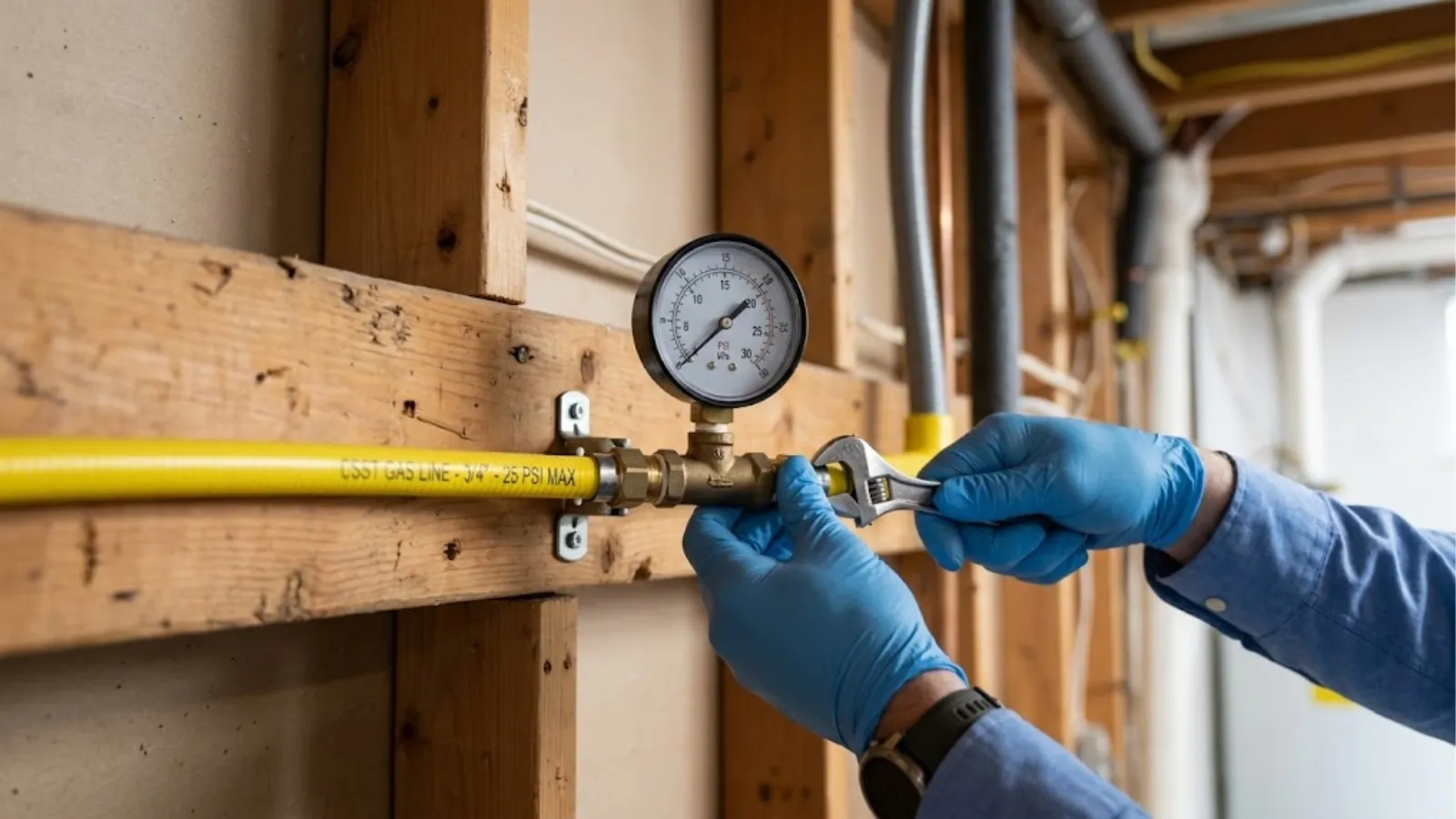
Gas line work is one area where cutting corners genuinely is not an option. Every installation and repair gets pressure tested before we consider the job complete, and every new appliance hookup is sized correctly for that specific appliance's demand.
Why Older Gas Lines Need Careful Evaluation
Black iron gas pipe common in homes built before the 1970s can corrode at threaded joints over decades, similar to how galvanized water supply lines corrode. A gas line that has never been inspected since the home was built is a reasonable thing to have checked, particularly before adding a new gas appliance that increases demand on the existing line.
Adding a new gas appliance, such as a range, a fireplace insert, or a tankless water heater, sometimes requires upsizing the existing line rather than simply tapping into it. The added demand can exceed what the current pipe diameter can safely deliver to every appliance on the line at once.
Signs You Need This Service.
- A sulfur or rotten-egg smell near an appliance or gas meter.
- A hissing sound near a gas line or fitting.
- A gas appliance that burns with a yellow flame instead of blue.
- Dead or discolored vegetation near an underground gas line.
- Unusually high gas bills with no change in appliance use.
How We Test A Gas Line
We pressure test the line to confirm it holds steady with no drop over time, which reveals even a small leak that might not be detectable by smell alone. Every new installation and every repair gets this same test before we consider the job complete, not just a visual inspection.
Emergency Gas Leak Response: Leave First, Then Call
If you smell gas, leave the building right away with everyone inside. Do not flip switches, use a phone or start a car near the building. From outside, call 9-1-1 and your gas utility. Do not go back in until the utility says it is safe.
After the utility has made the area safe, call our 24/7 line. We inspect the gas line, pressure test it and repair or replace the failed section so the system can be turned back on safely.
Smell gas or need a new appliance hookup?
Same-day service across Prescott, Prescott Valley, Chino Valley, and Dewey-Humboldt.
Repair Versus Line Replacement
A single failed fitting or a short damaged section is usually a straightforward repair. A line with corrosion at multiple points, or one that is undersized for a planned new appliance, is a better candidate for a longer section replacement or resizing rather than patching one spot and running into the same problem again soon.
A gas leak that causes sudden property damage is typically a covered event, though the underlying repair to the gas line itself is usually a maintenance cost.
Spot Repair Vs. Line Replacement
Single Fitting Repair
- Lower cost for an isolated failure.
- Faster to complete.
- Does not address other aging sections of the same line.
- Appropriate for a line otherwise in good condition.
Section Replacement Or Resizing
- Addresses corrosion along a longer run, not just one point.
- Necessary when adding a high-demand new appliance.
- Higher upfront cost than a single repair.
- Recommended for older black iron lines with multiple issues.
Gas Lines In Town And In The Forest Communities.
Homes inside Prescott often connect to a natural gas main, while properties farther out, such as forest communities like Groom Creek and Iron Springs, may run on propane instead. The fuel changes the pressure, the regulator, and the pipe sizing, so we confirm which one you have before planning a new range, fireplace, or tankless hookup. Every job is pressure tested, and older black iron near downtown gets a close look at the threaded joints.
Gas Line Calls: Leaks, Inspections And New Lines
Gas calls divide between suspected leaks and planned work. Homeowners ask for line inspections before buying, new lines for a range, dryer, fire pit or generator, and repairs after a smell of gas or a failed appliance connection.
Every new or repaired gas line gets a pressure test before it is put into service. We explain what the test showed and what the next step is.
Frequently Asked Questions
Leave the house immediately, do not operate any light switches or appliances, and call your gas utility's emergency line from a safe distance before calling a plumber.
In most cases, yes. We handle the permit and required inspection as part of the job rather than skipping it.
It depends on the line's current size and what is already connected to it. We calculate total demand before confirming whether the existing line works or needs upsizing.
Yes, across the full Quad City area.
Leave the building immediately and do not use switches or phones inside. From outside, call 9-1-1 and your gas utility. Call a plumber only after the utility has cleared the area.
If You Smell Gas.
- Leave the area immediately and do not operate any light switch, phone, or appliance inside the space.
- Do not attempt to locate the leak yourself or turn any valves on or off.
- Call your gas utility's emergency line from a safe distance, then call a licensed plumber.
- Do not return to the area until the utility or a professional confirms it is safe.
Service Area
We handle gas line installation and repair across Prescott's ZIP codes 86301, 86303, and 86305, plus the rest of the Quad City area, always with a permit and pressure test where required.